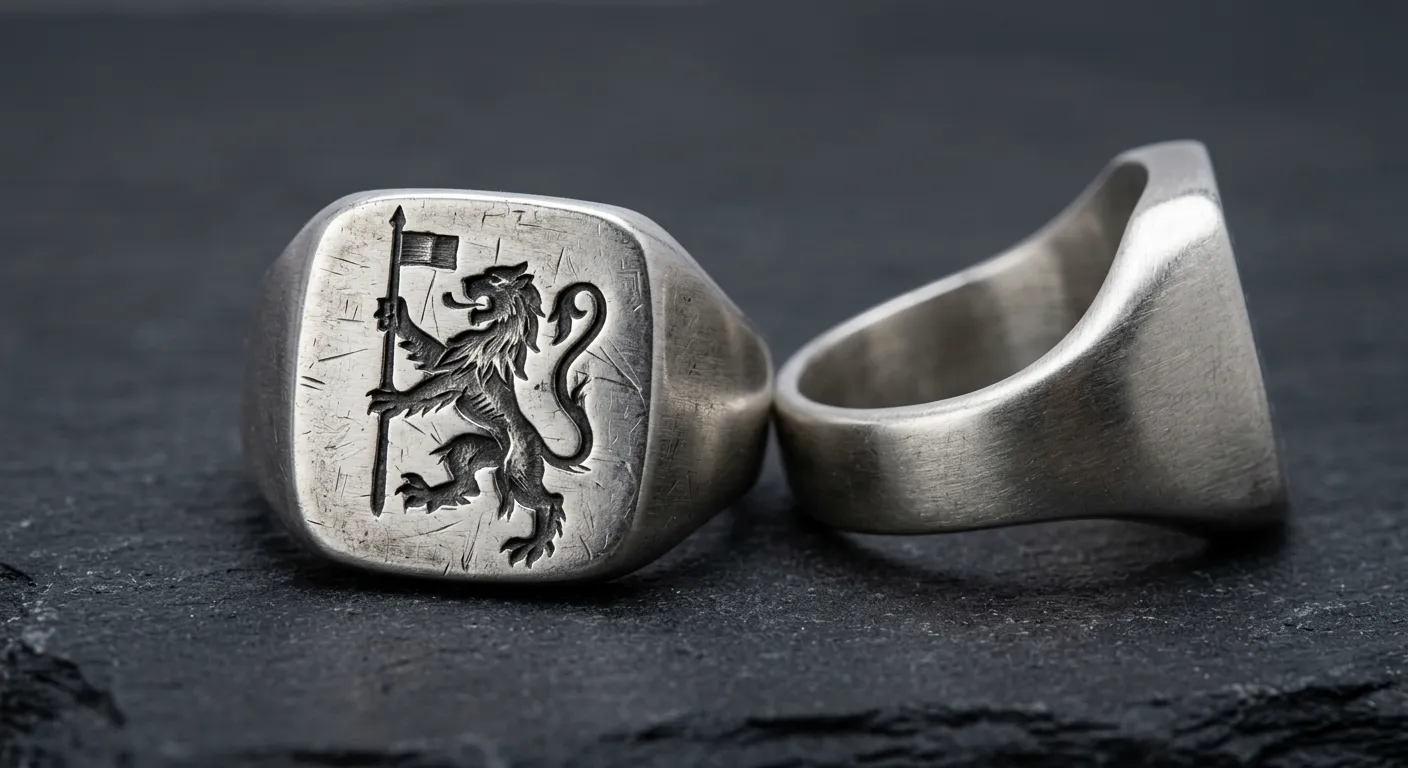
The men who wear accessories well are wearing fewer of them than you think. One ring, usually on the pinky or the index. A watch, already accounted for. A wallet thin enough to pocket without visible bulk. That's the full inventory.
The signet ring is the most useful place to start because it has a historical logic. It's functional in origin, a seal, which gives it a conceptual grounding that a decorative band lacks. In silver, it reads quiet. In gold, it reads louder. Either works if it's made well, sized correctly, and not competing with other rings on the same hand.
The leather card holder does more work than a bi-fold wallet in nearly every situation where a bi-fold is used. Three to four cards and a folded note of cash is the practical ceiling of what goes in a pocket anyway. Pull-up leather, which is vegetable-tanned and shows marks and color development over time, is the best choice for something handled daily. It will look worse at three months and significantly better at three years.
The cuff bracelet occupies a different register than a ring or a wallet because it sits on the wrist and competes visually with a watch. Wearing both works if they don't match in material; leather on one wrist and metal on the other creates separation. Wearing a steel bracelet next to a steel watch just compounds the metal.
A well-made single piece tells you something about the person. Three average pieces tell you they couldn't decide.
EDC, as a category, tends toward accumulation. The better instinct is to audit rather than add. Remove anything that doesn't have a reason to be in the rotation and see if anything is missing. Usually nothing is.
Verdict: One piece, chosen for material and specificity. A signet ring in silver or gold, made for you or inherited. A leather card holder in pull-up leather that darkens with use. A plain cuff bracelet in brass or oxidized silver. Not all three at once.


