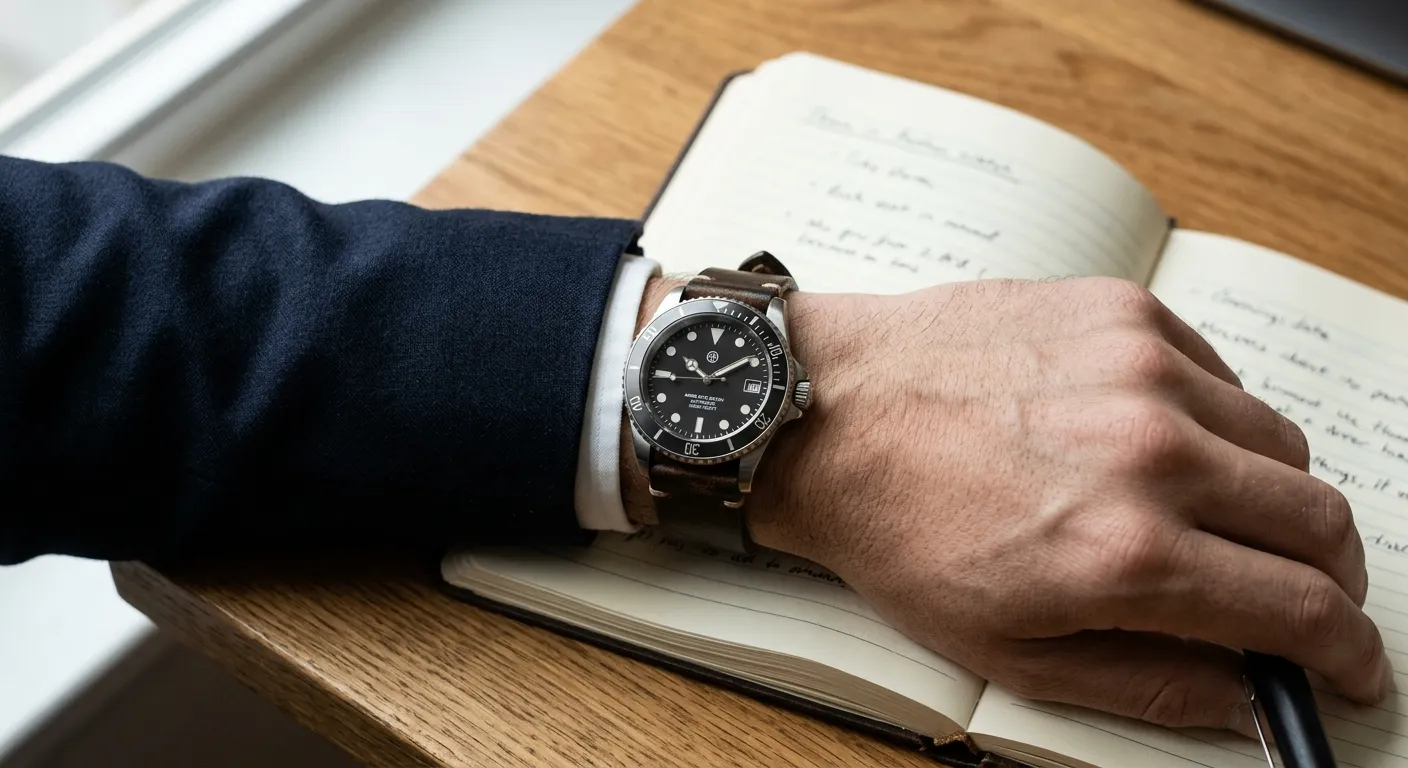
The dive watch arrived in offices in the 1960s because engineers and managers who owned one wore it everywhere. It wasn't a considered choice; it was the watch they had. The design held up in both environments, not because it was formal but because utility doesn't require justification.
That logic still holds. A 300m-rated dive watch in a 40mm steel case on a leather strap is indistinguishable at a business-casual read from a dress watch at a glance. The bezel is the tell; close up, it reads as technical. That's the whole range of the conversation.
The field watch is less polarizing than the dive watch in formal settings because it sits lower on the wrist. A 36mm to 40mm field watch with a canvas or leather strap barely registers under a jacket sleeve. The Arabic numerals and clean, high-contrast dial are actually more legible at a glance than most dress watches with applied indices. Legibility is the whole utilitarian thesis.
Brands that execute the tool watch correctly at accessible prices: Hamilton, Seiko, Tissot. At higher budgets: Tudor Black Bay, Longines Hydro Conquest, Oris Aquis. The common thread is that none of them are performing utility. The specifications, whether dive ratings, shock resistance, or power reserve, are real.
What makes a tool watch work in the office is the same thing that makes it work underwater: it doesn't ask anything of the context. You don't dress around it. You don't worry about scratching it in a meeting. You read it, wind it, and forget about it.
Utility without pretense reads as confidence. That's a posture the boardroom can rarely undermine.
Verdict: Buy if you want one watch for work and weekend without rethinking it at the door. Skip if the context is strictly formal; a dark-dialed dress watch will cover more ground in a boardroom. The alternative: Hamilton Khaki Field Mechanical, 38mm, hand-wound, under $500.


