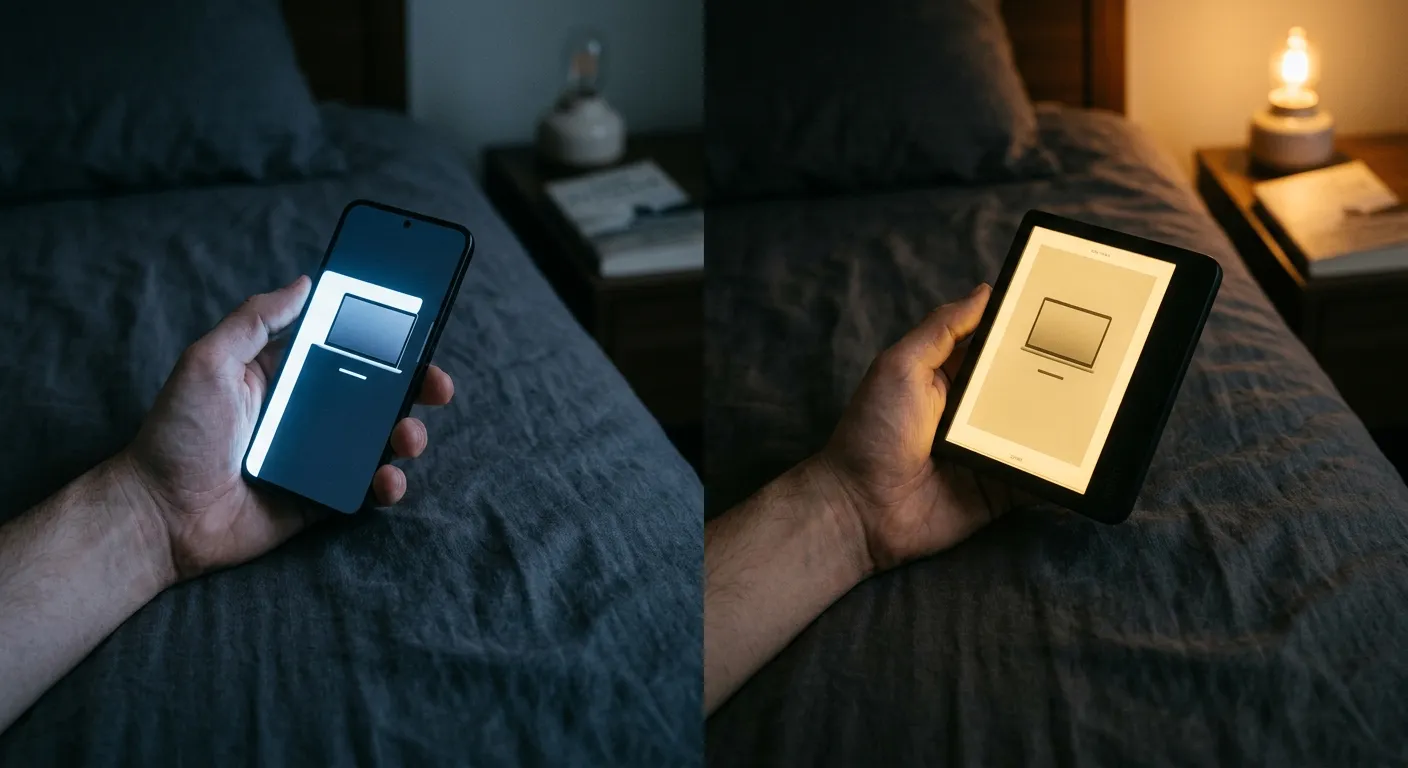
The case for an e-ink reading device is not about preferring a particular aesthetic or slowing down. It is about the physical difference between how OLED and e-ink displays generate the signal that reaches your retina, and what that difference does to your neurological state in the two hours before sleep.
OLED displays are emissive. The pixel generates light directly, at a brightness level calibrated to overcome ambient light and render the display visible. In low-light evening conditions, most people use their OLED phone or laptop at a brightness setting that still involves the display outcompeting the room. Emissive displays also pulse their backlight in a technique called pulse-width modulation: at lower brightness settings, the light cycles on and off at high frequency to simulate dimness. The frequency is typically in the hundred to three hundred Hz range. Some people can perceive this flicker as a headache or eye fatigue at high sensitivity; at the neurological level, the on-off cycling of a high-intensity emissive light source in a dim room is a stimulant input regardless of whether you consciously register the flicker.
E-ink displays are reflective. The display has no light source. It renders text by repositioning charged pigment particles, black and white, within a sealed capsule layer. The image is static between page turns; there is no refresh cycle during reading. The display draws power only during the state change, which is the page turn. Between page turns, zero energy is drawn and zero light is emitted. An external light source, a warm lamp, ambient daylight, reads off the surface the way it reads off a printed page. Your eye is doing the same task it does reading a book.
The failure mode of e-ink devices is the front light if equipped. Most modern e-ink readers include a built-in front light for low-light reading, which introduces an emissive element back into the equation. The difference is the quality of the light source: a good front light on an e-ink device uses a warm-spectrum LED array at low intensity, positioned to illuminate the page surface from the edge rather than from behind. A warm front light at minimum or medium brightness on an e-ink reader in a dim room is categorically different from a backlit OLED at medium brightness in the same conditions.
Battery life on e-ink devices runs in weeks rather than hours because the display draws power only at state changes. The battery is a standard lithium cell in most current readers. Kobo and Kindle both manufacture devices with replaceable batteries, though access varies by model. On a Kobo, battery replacement is accessible with a plastic spudger and a small screwdriver; iFixit publishes guides for most current models. On Kindle, the process is model-specific and ranges from straightforward to inadvisable without proper tools. A reader used daily for six to eight years will likely need one battery replacement; at fifteen to twenty-five dollars for the cell and thirty minutes of time, the repair cost is negligible.
The software environment on both major platforms degrades over time as the manufacturer deprecates older firmware. Plan on a hardware cycle of six to eight years, after which the device may no longer receive security patches or format support. For a dedicated reading device used offline, firmware staleness is less consequential than for a connected device. E-ink hardware itself does not wear in the way that OLED does: OLED panels degrade through organic light-emitter decay, typically showing measurable luminance reduction at peak brightness within three to five years of heavy use. E-ink panels do not self-illuminate and do not exhibit the same decay mechanism. An e-ink screen in year seven looks like it did in year one.
If you read for more than thirty minutes before sleep and you are using a phone or tablet to do it, you are making a measurable trade against sleep onset time for no functional reason. A current Kobo Libra or Clara runs between one hundred and one hundred fifty dollars. It does one thing, does it correctly, and the hardware mechanism does not work against the purpose the device serves.