Marketing lumen ratings for EDC flashlights are accurate for approximately ninety seconds. After that, the number that matters is not the peak, it is what the light stabilizes at once thermal throttling kicks in.
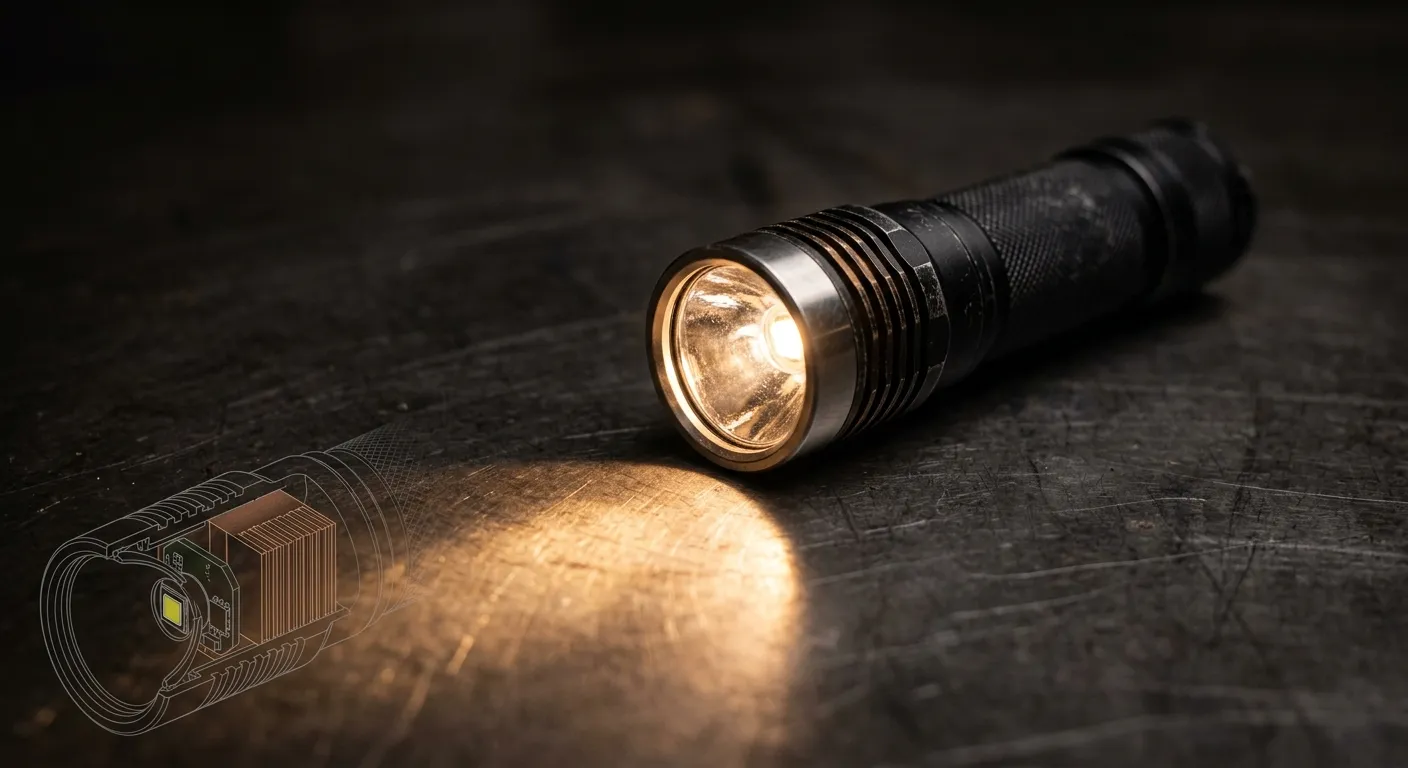
Here is the mechanism. LEDs generate heat at the junction between the emitter and its substrate. As junction temperature rises, output drops and the driver circuit reduces current to prevent a thermal runaway that kills the emitter. A well-designed flashlight manages this with a sufficient aluminum heatsink mass surrounding the emitter, a short thermal path between the LED board and the body, and a driver circuit with a governed ramp-down that settles at a sustainable output rather than cutting to ten percent in a panic. A poorly designed one hits two thousand lumens for a burst, thermally collapses, and stabilizes at three hundred, which you could have gotten from a fifteen-dollar light.
The specifications that actually matter are: ANSI/NEMA FL1 tested sustained output at thirty minutes, not peak output; body material and wall thickness at the head, because that is your heatsink; and the driver topology, regulated versus direct drive.
Regulated drivers maintain consistent output across the battery's discharge curve. Direct drive drivers are brighter when the battery is fresh and dim progressively as voltage drops. For a work light or a light you reach for in an emergency, regulated is the correct architecture.
Battery replaceability is non-negotiable for recommending any light in this category. Lights that use proprietary lithium packs are landfill at the pack's first death, typically two to four years of regular cycling. Lights built around 18650 or 21700 cells are serviceable; those cells are available everywhere and cost under ten dollars. Swap the cell and the light runs another decade.
What fails first, in order: the O-ring at the head and tail cap, which controls waterproofing; the switch mechanism, which on cheaper lights is a press-fit rubber boot over a carbon-contact PCB pad; and the driver circuit if the light is regularly pushed to maximum for sustained periods. O-rings are universal and available at any hardware store in the correct diameter. Switch boots and driver boards are model-specific, which is where buying from a manufacturer with a parts catalog pays off. Acebeam, Fenix, and Olight all publish spare part availability, though Olight's proprietary cell policy offsets some of that goodwill.
A light with a 5000K to 5700K emitter in a 21700-cell body with an aluminum alloy head, a regulated driver, and published ANSI FL1 thirty-minute output numbers is the thing to buy. Anything that leads with peak lumens in the product name and buries thirty-minute output in footnotes is optimized for the shelf, not the job.
Year three: swap the tail-cap O-ring and inspect the switch boot. Year seven: assess the cell capacity with a charger that reads mAh; if capacity is below eighty percent, replace the cell. The body and driver should still be functional. Cost per year of use on a properly built light in the sixty to one hundred twenty dollar range works out to eight to fifteen dollars annually over an eight-year service life.