Color Rendering Index is not an audiophile concept where the numbers justify the obsession. It is measurable, visible, and the single most important spec for any bulb going into a living space. Most people have never looked at it.
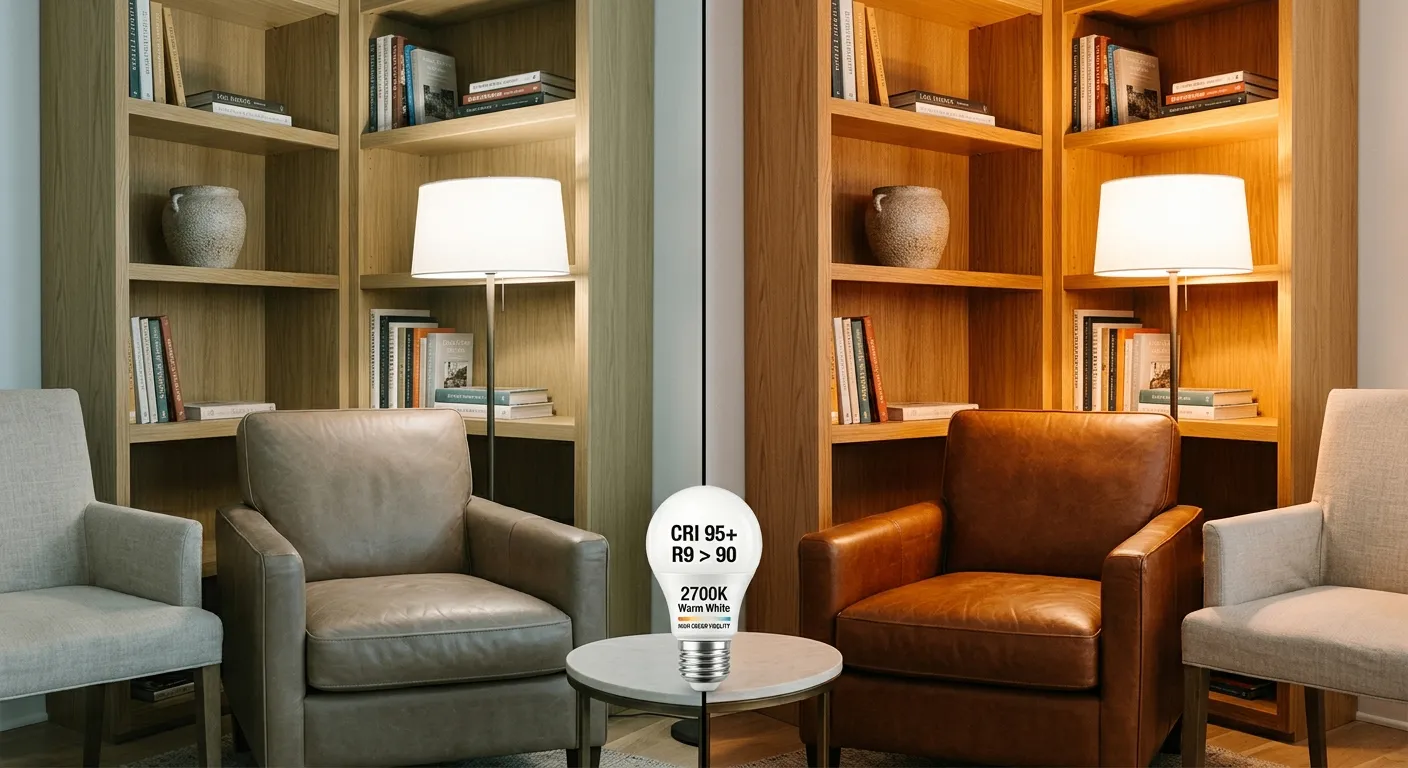
CRI is a scale from 0 to 100 measuring how accurately a light source renders color compared to a reference illuminant: essentially, compared to sunlight or incandescent light at the same color temperature. A CRI of 100 means the colors in the room look the way they would in daylight. A CRI of 80, which is what most LED bulbs sold at hardware chains achieve, means roughly twenty percent of the color information in the room is being compressed or shifted. Your leather sofa looks slightly gray. Your wooden bookshelf looks slightly green. You have been adapting to this for years without knowing it.
The specific value that separates a bad LED from a useful one in a living space is the R9 score. CRI is an average of eight color samples. R9 is the ninth sample, a saturated red, and it is not included in the CRI average because it drags the number down and manufacturers omit it. Saturated reds appear in skin tones, in warm wood grains, in nearly every textile color your eye reads as warm. A bulb with a CRI of 90 and an R9 of 50 looks notably worse in lived-in spaces than a bulb with a CRI of 90 and an R9 of 90. Buy bulbs where the R9 is published. If the packaging does not list R9, the number is bad.
Color temperature and CRI are separate axes. A 2700K bulb (warm white) with a CRI of 80 still renders color poorly; it just renders it poorly in a warm tone. The target for a living room with natural wood, leather, or textile-heavy surfaces is 2700K to 3000K at CRI 90 or above with published R9 above 80. Waveform Lighting, Soraa, and a handful of Japanese manufacturers publish R9 on their packaging. Most do not.
LED failure in quality bulbs at this CRI range is almost never the LED itself. Phosphor packages on high-CRI LEDs are more complex and the phosphor layer degrades at a different rate than the driver. In a quality bulb, the first failure is typically the electrolytic capacitor in the driver circuit, which dries out from heat cycling over three to seven years. You cannot repair this in a consumer bulb because the driver is potted in epoxy. You replace the bulb. The calculus is straightforward: a four-dollar bulb at CRI 80 that lasts five years costs less than a fifteen-dollar bulb at CRI 95 that lasts seven years, but you are buying the fifteen-dollar bulb for what it does to the room in the meantime, not for its lifespan economics.
At year three, check your warm-toned surfaces in direct lamplight against what they look like outdoors in afternoon light. If the gap has grown, you are either in bulb degradation or you started with a poor CRI choice. The fix in either case is the same bulb selection decision you should have made at the beginning.