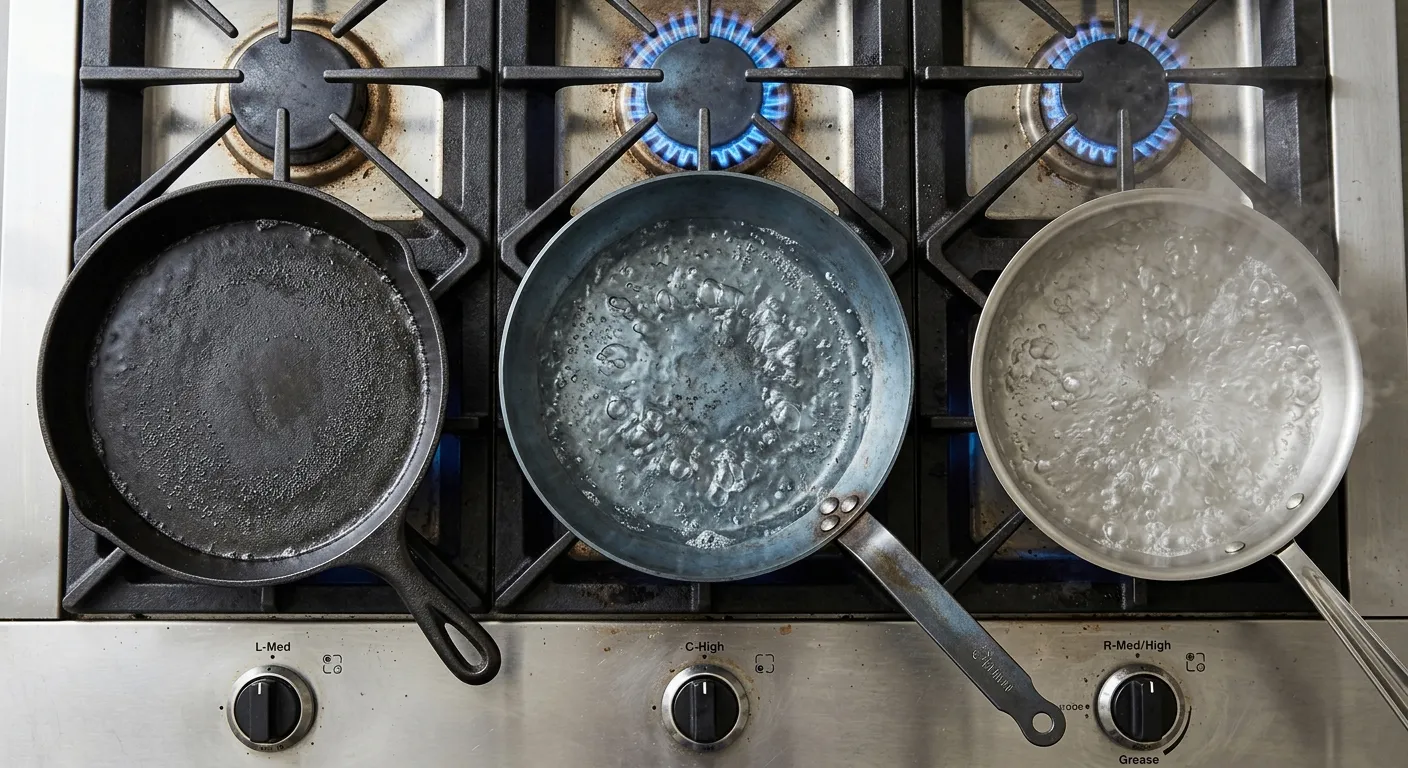
The pan material question is not about which metal is best. It is about matching heat behavior to your stove and your cooking pattern. A pan that performs correctly in one context is actively wrong in another, and no amount of seasoning changes the physics.
Cast iron's thermal mass is its defining characteristic. It takes longer to heat uniformly, but once it is at temperature, the large mass resists temperature drop when cold food hits the surface. On a home burner producing fifteen thousand BTU or less, cast iron can be difficult to bring to a uniform temperature because the burner contact area is smaller than the pan diameter, creating hot spots at the center and cooler zones at the edges. On a restaurant range running thirty to fifty thousand BTU, this is less of a problem because the flame pattern covers more of the pan floor. The practical application at home: cast iron works well for tasks where you preheat long enough to equalize temperature, which is fifteen to twenty minutes in an oven followed by a transfer to the burner. It is well-suited to cornbread, roasts, and high-heat sears on thick proteins where you are not moving the pan. At year ten, the seasoning layer is functional, the iron is not significantly different from year one, and restoration from rust is possible with a wire wheel and a seasoning cycle.
Carbon steel is typically two millimeters thick versus four to six millimeters for cast iron. It heats faster and more evenly at lower BTU because the smaller mass does not require as much energy to bring to temperature, and the thinner cross-section conducts heat laterally faster across the pan floor at typical home ranges. It responds to burner adjustments more quickly than cast iron, which makes it better for tasks where you are varying temperature during the cook: eggs, fish, sauteed vegetables. The tradeoff is lower thermal mass, meaning cold proteins cause more pronounced temperature drop. Carbon steel is the professional kitchen standard for saute pans for exactly this reason: high reactivity, low mass, fast recovery when the burner is at sufficient output.
Clad stainless, typically an aluminum or copper core bonded between stainless layers, conducts heat faster than either iron or carbon steel and does not require seasoning. Aluminum core clad is the budget-friendly construction; copper core conducts heat faster still and costs proportionally more. The stainless exterior is inert and does not react with acidic foods, which is the primary functional reason to own clad stainless alongside carbon steel. Braises with wine, tomato-based sauces, anything with vinegar benefits from a non-reactive surface. Clad stainless is the most repairable pan in the sense that there is nothing to degrade; it cannot rust and does not require maintenance. The handles are the failure point: riveted handles are permanent, and a loose rivet is a warranty or repair question depending on the manufacturer.
At year seven: cast iron and carbon steel are indistinguishable from new with basic maintenance. Clad stainless exterior staining is normal and does not affect performance. Pan selection based on cooking style rather than brand preference is a permanent decision; buy one of each construction type and the overlap between them covers every task a home stovetop demands.