Most stripped screw heads are not the result of cheap hardware. They are the result of using the wrong driver geometry on the right screw. If you have ever worked on a Japanese carburetor, a vintage Pentax, or a Nakamichi deck and watched the head round out under a driver that felt like it fit, you already know the problem. You just did not know it had a name.
Phillips screws were designed in the 1930s with intentional cam-out. The driver is meant to slip out of the head before it overtorques and snaps the fastener. That is useful on a production line. It is destructive on precision Japanese hardware assembled to tighter tolerances with harder steel and smaller heads. Japanese Industrial Standard cross-point fasteners, JIS B 1012, look nearly identical to Phillips. The key difference is the angle of the four flanking lobes: JIS flanks are cut at a tighter radius with shallower ramps and no cam-out relief. A JIS driver sits flush and transfers torque straight down. A Phillips driver, run into the same recess, contacts only the outer edges and cams out sideways under any real load.
The practical result: one wrong pass with a Phillips on a JIS carburetor jet screw and you have a head that is no longer extractable without a screw extractor, a drill, and twenty minutes of profanity.
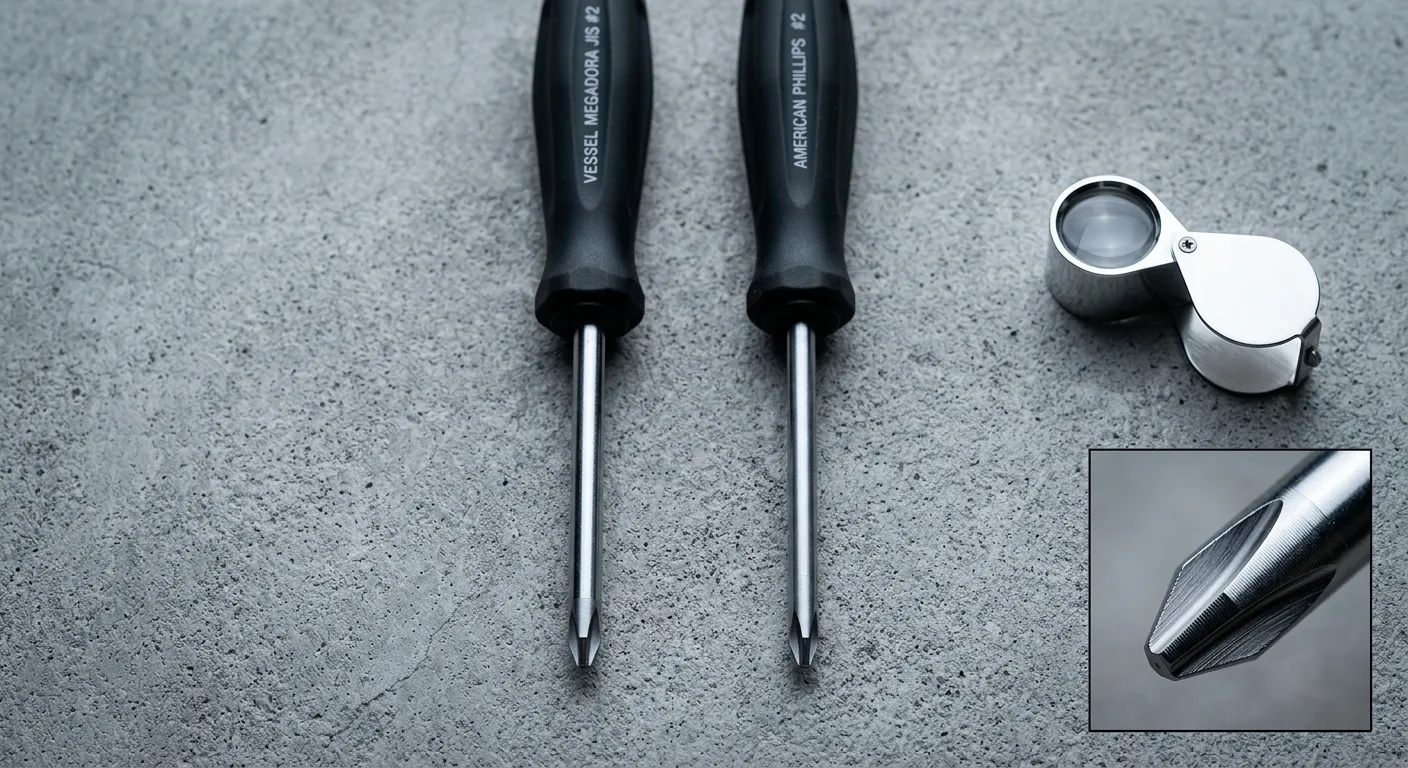
The fix costs under forty dollars and covers most of your repair life. Vessel, Anex, and Engineer all manufacture JIS sets ground to spec. The Vessel 220 series and the Anex 3100 are the common recommendations in repair communities, available through Japanese tool importers and a few specialty retailers. Both are rated to hold their geometry through sustained torque without rounding their own flanks. Buy a set that runs from JIS #0 through #3 and a magnetized handle is worth the slight premium for overhead work.
What fails first with any driver is the tip geometry. Budget bits are stamped rather than ground; they lose their precision at the flanks within a year of regular use. Ground tips hold their form. If you cannot find spec confirmation, look at the tip under a loupe; a stamped tip has visible seams at the flank radius, a ground tip does not.
Keep the JIS set separate from your Phillips set. They look identical in a drawer. Labeling them is not obsessive, it is functional. Your camera's shutter assembly screws will thank you in year eight when you go back for a second adjustment.
Who should own a JIS set: anyone who works on motorcycles, vintage audio, cameras manufactured in Japan before 1990, or any precision Japanese consumer electronics. Who does not need one: woodworkers and electricians whose hardware is uniformly North American or European standard. The alternative is Wiha's precision Phillips set, which costs more and solves a narrower problem. For Japanese hardware specifically, there is no substitute.