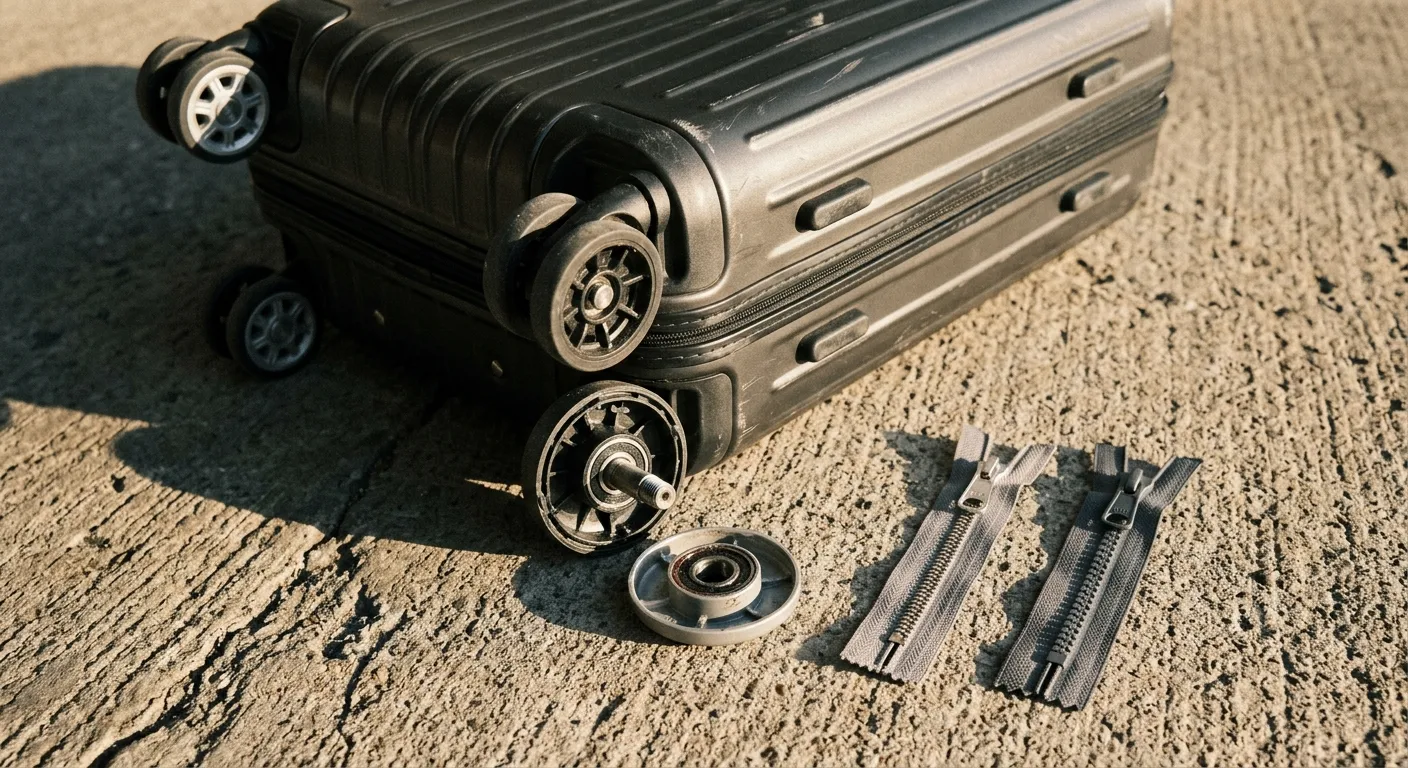
The handle breaks. The zipper stalls. The wheel pops off. Every piece of luggage eventually fails at one of these three points, and none of them have anything to do with the shell material the marketing department spent all its copy on.
Zippers fail from two directions: the slider loses clamping tension on the teeth and skips, or the teeth themselves separate under lateral stress on an overpacked bag. YKK coil zippers and YKK molded tooth zippers handle these failure modes differently. A coil zipper is a continuous spiral of nylon that runs through the slider; when the slider wears and loses tension, a coil zipper can often be corrected by squeezing the slider body with pliers to restore clamping force. The repair takes two minutes and costs nothing. A molded tooth zipper uses individual polycetal or metal teeth molded directly onto the tape; when a molded tooth separates, you replace the zipper. There is no field fix. For everyday bags and camera bags where you open and close the main compartment twenty times a day, coil is the more forgiving architecture. For luggage under high lateral stress when overpacked, a large-gauge molded tooth zipper handles the load better.
The slider pull itself separates from the slider body on cheap luggage within eighteen months. On quality luggage, this joint is a reinforced casting; on entry-level bags, it is a thin stamped loop through a thin stamped ring. Pull the zipper on a bag in the store. Apply lateral force at the pull-to-slider connection. If it flexes, it will fail.
Wheels on carry-on luggage are the second failure point. Injection-molded polycarbonate wheels on a full-size carry-on running across cobblestone or cracked city sidewalk are rated for smooth surfaces and do not survive contact with the real world for more than three years at heavy travel frequency. The difference between acceptable and unacceptable wheels is the hub construction: a full-axle rod running through a bearing insert is repairable; a press-fit stub axle is not. Rimowa and a small number of other manufacturers sell replacement wheel sets as spare parts. Most do not. If the brand cannot tell you the part number for a replacement wheel, the bag ends its life when the first wheel cracks.
Telescoping handles fail at the locking collar, not the tube. The collar is a spring-loaded plastic insert that clicks the handle into position at height; over time, the spring loses tension or the insert fractures, and the handle no longer locks at full extension. On luggage where the collar assembly is accessible from the inside of the bag body with the lining peeled back, an experienced repair shop can replace it. On bags where the collar is over-molded into the frame, it is a structural write-off.
At year three: inspect the zipper slider clamping tension on your main compartment. Inspect the wheel axle for lateral play. At year five on a bag used for fifteen or more trips per year, plan on a wheel replacement if they are available, and assess the handle collar. A hard-shell bag in the two hundred fifty to four hundred dollar range with YKK zippers, published spare parts for wheels, and an accessible handle collar is a fifteen-year proposition if you do not check it once. The alternative is spending eighty dollars every three years and never building any knowledge of what you own.